Influencer Marketing vs. Paid Social Ads: Which Strategy Delivers Better Results?
Not sure whether to invest in influencer marketing or paid social ads? Both promise results — but they work very differently. This guide breaks down the key differences between influencer marketing vs. paid social ads, covering cost, targeting, trust, ROI, and when to use each strategy so you can make the right call for your brand.
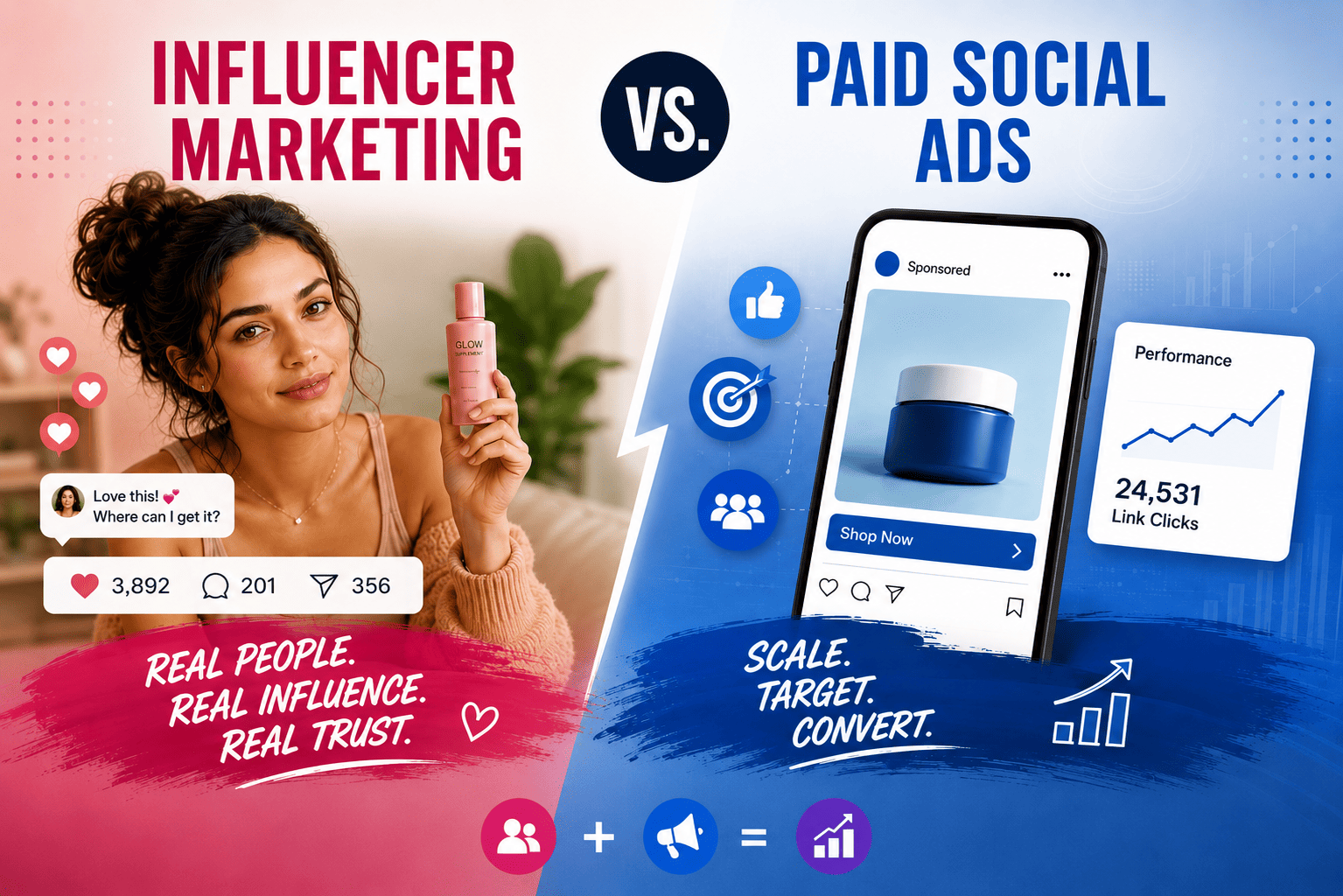
Every brand reaches a point where they need to make a critical decision: where should the marketing budget actually go? Two of the most debated options right now are influencer marketing vs. paid social ads. Both strategies promise visibility, engagement, and conversions — but they work very differently, suit different goals, and come with their own trade-offs.
This guide breaks down everything you need to know about influencer marketing vs. paid social ads, so you can make a data-backed decision for your brand — not just follow the trend.
What Is Influencer Marketing?
Influencer marketing is a strategy where brands partner with individuals — creators, bloggers, or social media personalities — who have an established audience that trusts their recommendations. Instead of pushing a traditional ad, you're essentially borrowing the credibility of someone your target audience already follows.
These partnerships can take many forms:
- Sponsored posts on Instagram, TikTok, or YouTube
- Product reviews and unboxings
- Long-term brand ambassador deals
- Affiliate collaborations tied to commissions
- Co-created content or limited-edition product lines
Influencer marketing works across all tiers — from mega-influencers with millions of followers to nano-influencers with a highly engaged audience of just a few thousand. In fact, smaller influencers often deliver higher engagement rates and more authentic results for niche brands.
Want to understand the full picture? Read our in-depth guide on influencer marketing to see how brands are using it to drive real growth.
What Are Paid Social Ads?
Paid social advertising means paying platforms — Facebook, Instagram, TikTok, LinkedIn, Pinterest, X (formerly Twitter) — to display your content to a targeted audience. You set a budget, define your audience using the platform's targeting tools, and your ad gets shown to users who match your criteria.
Common paid social ad formats include:
- Image and carousel ads
- Video ads (in-feed, Stories, Reels)
- Lead generation ads
- Retargeting ads for website visitors
- Dynamic product ads for e-commerce
Paid social gives you granular control over who sees your content — down to age, location, interests, behaviors, job title, and even life events. You also get detailed analytics on reach, clicks, cost-per-click (CPC), and return on ad spend (ROAS) in real time.
Influencer Marketing vs. Paid Social Ads: Key Differences
Before picking a side, it helps to understand exactly where these two strategies diverge. Here's a direct comparison of the most important factors:
1. Trust and Authenticity
Influencer Marketing: People follow influencers because they trust their opinions. A recommendation from a creator feels personal — more like advice from a friend than an advertisement. Studies consistently show that consumers trust peer recommendations far more than brand-run ads.
Paid Social Ads: Audiences are increasingly aware they're being advertised to. Ad fatigue is real, especially among younger demographics who are quick to scroll past anything that feels promotional. That said, well-crafted creative and honest messaging can still cut through.
Edge: Influencer Marketing
2. Targeting and Reach
Influencer Marketing: Your reach depends on the influencer's existing audience. While you can choose influencers whose followers match your ideal customer profile, you can't drill down the way you can with ad platforms. You're reaching their community, not building one from scratch with precision targeting.
Paid Social Ads: This is where paid social shines. Platforms like Meta allow you to build highly specific audience segments — down to interests, purchasing behaviors, device usage, and lookalike audiences based on your existing customers. This level of control is unmatched.
Edge: Paid Social Ads
3. Cost Structure
Influencer Marketing: Costs vary wildly. A nano-influencer might charge $100–$500 per post. A celebrity influencer or top-tier creator can charge $50,000 or more for a single piece of content. Pricing isn't standardized, and negotiation is part of the process. You also pay upfront with results that are harder to predict.
Paid Social Ads: You set your own budget and can start with as little as $5 per day. You only pay when users take an action (clicks, impressions, or conversions), and you can pause or scale campaigns in real time based on performance.
Edge: Paid Social Ads (for budget flexibility); Influencer Marketing (for fixed-fee partnerships at scale)
4. Content Longevity
Influencer Marketing: A well-made piece of influencer content can have a long shelf life. A YouTube review stays searchable for years. A TikTok can go viral long after it was posted. You also gain the right (in most contracts) to repurpose influencer-created content in your own ads.
Paid Social Ads: Ads run only as long as you're paying for them. Once the budget stops, so does the visibility. There's no organic afterlife for a paid ad.
Edge: Influencer Marketing
5. Measurability and Analytics
Influencer Marketing: Tracking ROI from influencer campaigns can be messy. You'll rely on UTM links, discount codes, and platform insights — which influencers may or may not share in full. Attribution is harder to pin down, especially for top-of-funnel awareness campaigns.
Paid Social Ads: Every metric is trackable — impressions, clicks, conversions, cost-per-lead, ROAS. You know exactly what each dollar is doing. A/B testing is built in. If something isn't working, you know immediately and can pivot.
Edge: Paid Social Ads
6. Speed to Results
Influencer Marketing: Campaigns take time. You need to find the right influencer, negotiate terms, brief them, wait for content creation, review, and then publish. From outreach to results, you're often looking at weeks or months.
Paid Social Ads: Campaigns can go live within hours. You write copy, design a creative, set up targeting, and launch. Results start coming in almost immediately.
Edge: Paid Social Ads
When Influencer Marketing Works Best
Influencer marketing isn't the right fit for every brand or every campaign. But when the conditions are right, it's one of the most powerful tools in a marketer's playbook.
Consider influencer marketing when:
- You're building brand awareness from scratch. If people don't know your brand exists, a trusted creator can introduce you to a relevant audience far more effectively than a cold ad.
- Your product needs demonstration. Beauty, fitness, food, tech gadgets, and lifestyle products benefit enormously from seeing real people use them in context.
- You're targeting a tight niche. Micro and nano-influencers in specific communities (gaming, sustainable living, parenting, finance) often have audiences that are nearly impossible to replicate through ad targeting alone.
- You want content you can repurpose. Influencer-created content can be used in paid ads, email campaigns, and on your website — giving you strong creative at a relatively low production cost.
- You're launching a new product. A coordinated influencer push at launch can generate buzz, social proof, and initial sales momentum that a paid campaign alone often can't replicate.
When Paid Social Ads Work Best
Paid social advertising gives you control, speed, and scalability that influencer campaigns simply can't match in certain scenarios.
Paid social is the stronger choice when:
- You need immediate results. Driving traffic to a sale, promoting an event, or filling a webinar? Paid ads deliver fast.
- You have a proven offer and want to scale it. If you already know your messaging converts, paid ads let you pour fuel on the fire with predictable returns.
- Retargeting is part of your strategy. Showing ads to people who already visited your website or added something to their cart is one of the highest-ROI tactics available — and it only works through paid social.
- You need precise audience control. B2B brands, local businesses, or highly specific customer demographics benefit from the surgical targeting that ad platforms provide.
- Your budget is limited and you need accountability. Every dollar in a paid campaign is tracked. You know what's working and can cut what isn't without guessing.
Can You Use Both Together?
Absolutely — and in most cases, the smartest brands do exactly that. Influencer marketing and paid social ads aren't competitors; they're complements.
Here's how a combined strategy typically works:
- Use influencers for awareness and content creation. Let creators introduce your brand to their audiences and produce authentic content in the process.
- Repurpose that content in paid ads. Influencer-style creative (also called "dark posts" or "whitelisted ads") consistently outperforms traditional brand ads in performance benchmarks. It looks native, not promotional.
- Retarget engaged audiences with paid social. Users who saw the influencer content but didn't convert can be retargeted with a more direct, offer-driven ad.
- Use paid social to amplify your best-performing influencer content. Boost posts that are already getting organic traction to extend their reach at a fraction of the cost of producing new creative.
This flywheel approach gets you the authenticity and trust of influencer marketing with the precision and scalability of paid social — the best of both worlds.
Common Mistakes Brands Make When Choosing
Understanding the difference between influencer marketing vs. paid social ads isn't enough if you fall into these common traps:
- Choosing influencers based on follower count alone. Engagement rate, audience quality, and niche alignment matter far more than raw numbers. A million followers with 0.2% engagement is worth less than 50,000 highly engaged followers in your target market.
- Running paid ads with untested creative. Launching a big paid campaign with one piece of creative and no A/B testing is a budget gamble. Test multiple ad variations before scaling.
- Expecting influencer campaigns to drive direct conversions immediately. Most influencer content works at the top of the funnel. If you're measuring success purely by immediate sales, you'll likely be disappointed — and miss the bigger picture.
- Ignoring the paid amplification opportunity. Brands leave significant value on the table when they don't put paid spend behind organic influencer content that's already performing well.
- Not briefing influencers properly. Overly controlling briefs kill authenticity. Overly vague briefs produce off-brand content. Find the middle ground: share your goals, key messages, and must-avoids — then let creators do what they do best.
Influencer Marketing vs. Paid Social Ads: Which Should You Choose?
The honest answer is: it depends on where you are as a brand and what you're trying to achieve.
If you're a new brand with a story to tell and a product that benefits from demonstration, start with influencer marketing to build credibility and awareness. Use the content you generate to feed your paid social engine.
If you have a proven product, an existing audience, and a need to scale revenue quickly, paid social gives you the control and accountability to do that efficiently.
If you have the budget and bandwidth to do both — do both. The brands winning on social right now aren't choosing between these two strategies. They're integrating them into a single, reinforcing system.
Explore how leading brands are structuring their influencer marketing strategies to get the most out of every campaign dollar.
Frequently Asked Questions (FAQ)
Is influencer marketing more expensive than paid social ads?
Not necessarily. Paid social costs depend on your target audience, industry competitiveness, and campaign scale — costs can rise significantly in competitive verticals. Influencer marketing costs vary by creator tier, but nano and micro-influencers can be very affordable. The key is calculating cost-per-result, not just upfront spend.
Which delivers better ROI — influencer marketing or paid social ads?
It depends on the goal. Paid social typically delivers more measurable, short-term ROI because every action is tracked. Influencer marketing often delivers stronger long-term brand equity, trust-building, and content value — which are harder to quantify but equally important for sustainable growth.
Can small businesses afford influencer marketing?
Yes. Nano-influencers (1,000–10,000 followers) often charge very little or will accept product gifting in exchange for content. For small businesses targeting niche communities, this can be an extremely cost-effective strategy compared to running paid ads in a competitive ad auction.
How do I measure the success of an influencer marketing campaign?
Use a combination of metrics: reach and impressions (awareness), engagement rate (resonance), website traffic from UTM-tracked links, discount code usage (direct conversions), and brand search volume lift. Comparing these against your campaign goals will give you a clearer picture of ROI.
What's the biggest advantage of paid social ads over influencer marketing?
Control and real-time optimization. With paid social, you can precisely define who sees your ad, how much you spend, and pause or adjust campaigns instantly based on performance data. This level of control simply doesn't exist with influencer campaigns.
Should I use influencer content in my paid ads?
Absolutely. Repurposing influencer content as paid ads (often called whitelisted or dark posts) is one of the most effective tactics in modern social advertising. It combines the authenticity of creator content with the targeting precision of paid social — and typically outperforms traditional brand-produced ad creative.
How do I find the right influencers for my brand?
Look for influencers whose audience demographics match your target customer, whose content style aligns with your brand values, and who have an engagement rate that indicates genuine community connection. Platforms like influencer marketplaces and agencies can help, or you can search natively on TikTok, Instagram, and YouTube using relevant hashtags and keywords.
Continue Reading
Related influencer marketing insights
Influencer Marketing for Travel Brands: Complete Guide (2026)
Discover how travel brands use influencer marketing to build trust and drive bookings. Learn campaign types, creator selection tips, and how UGC boosts ROI

Top 10 Dance Influencers in India on Instagram in 2026
Discover the top 10 dance influencers in India on Instagram in 2026 — from Awez Darbar’s 30M+ followers to rising stars shaking up the scene. Find the perfect creator for your next influencer marketing campaign.
Top 10 Mom Influencers in India 2026
India is home to some of the most influential mom creators on Instagram, and in 2026, their impact on parenting culture and brand marketing has never been stronger. From Bollywood celebrities like Neha Dhupia and Debina Bonnerjee to niche experts like Dr. Pallavi Rao Chaturvedi, these women are shaping how millions of Indian mothers think, shop, and raise their children.